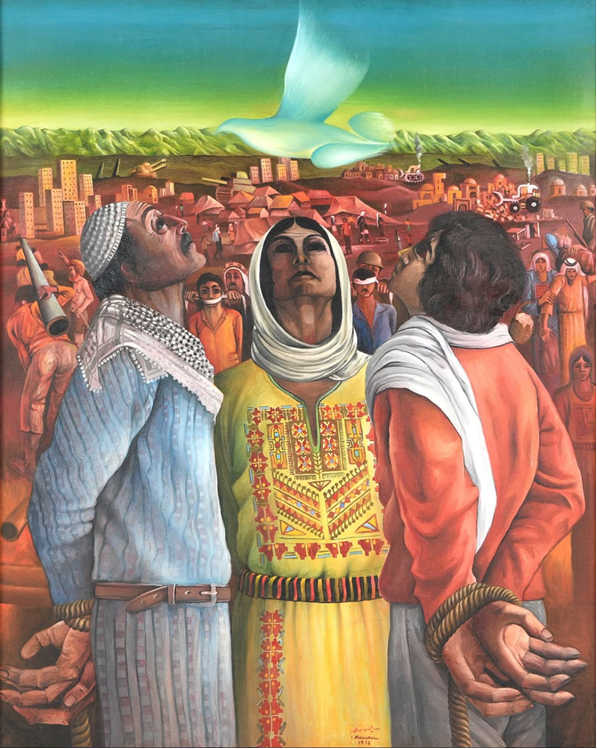
| by Jonathan Kuttab This week was dominated by two significant events. The first is the passing of Sliman Mansour, an iconic and beloved artist who has come to symbolize Palestine and its struggle. Many of you have seen his paintings, but I knew Sliman as a friend of many years. He is gentle and humble, with a sense of humor, and is eternally energetic and dedicated to serving the public through his art and his life. He was fiercely independent of any political party, yet he was willing and eager to work with everyone to advance the Palestinian cause and to assist his fellow artists. While he is well known throughout the world as the foremost artist from Palestine, not everyone knows that he was a Christian from Birzeit and that his faith is also reflected in his art. It was the most natural manifestation of the fact that Christian Palestinians are not just a minority but an essential and integral component of Palestinian identity, just as the colored threads of Palestinian embroidery (tatreez) are an essential part of a Palestinian thobe (dress). The other significant event, or rather “crisis,” dominating Israeli news, radio and TV broadcasts this week concerns the “security threat” emanating from Gaza in the form of kites, balloons, and reportedly one child’s drone that flew in or was blown by the wind from Gaza into the surrounding area of the Israeli kibbutzim. The army clearly indicated that these “incursions” did not constitute a threat and carried no explosive or incendiary materials, but that was irrelevant. In the minds of the residents of the kibbutzim surrounding Gaza, they were scary reminders of the troublesome existence and potential capabilities of Gazans and of Hamas, and that the threat of October 7 may be visited on Israelis again. They demanded (and got!) an immediate military response: The prime minister and defense minister issued stern orders to the military to “act massively, against this threat and the areas from which it came. Hamas was given three days to put an end to this “breach” of the ceasefire. Israel issued orders to target and eliminate those who fly the kites and threatened to depopulate the entire area from which the offending materials were launched, regardless of whether they contained flammable or explosive materials or not. The resultant strikes killed at least three Palestinians, including a four-year-old child. The ‘Board of Peace” also chimed in, insisting that Hamas strictly refrain from any military activity, including kites and balloons, while urging Israel to limit its targeted attacks to “imminent dangers” to Israel or to its forces in Gaza. This fear of kites would be hilarious if it were not so deadly serious, with literally fatal consequences. It is my belief that this represents not just an excuse to continue killing and bombing Palestinians and “normalize” the ongoing genocide, but it is a symptom of a far more serious and deep sickness within Israeli society in general. First of all, it reveals an utter lack of psychological and emotional security that no amount of military hardware or destructive capabilities can ever satisfy. Israelis feel so insecure, fearful and vulnerable to attack because they know they have wronged the Palestinians and believe they will never feel safe as long as Palestinians exist. This also explains the recent attacks on monuments commemorating fallen Palestinians. Art like Sliman Mansour’s, nonviolent calls for Boycott, Divestment, and Sanctions against Israeli war criminals and complicit institutions, appeals to international courts, public demonstrations, raising a Palestinian flag, are interpreted as threats. Everything is dangerous and triggers irrational fears and anxiety, requiring therefore an immediate and disproportionate response to crush and eliminate the “threat” being posed. This is why we cannot let Israel be the arbiter of what is required for its security, since its perception of “security” is so subjective and irrational. Whether it is the historical memory of persecution and the holocaust, or whether it concerns recent memories of losses arising out of Palestinian resistance, Israelis feel pathologically scared and vulnerable. No amount of military might will ever provide them a sense of security. In this highly charged atmosphere, the most outrageous behaviors and proposals gain popularity in Israel regardless of actual reality. Secondly, this incident exposes an utter self absorption and narcissism on the part of Israel, such that it can only see things from its own perspective. Israelis seem incapable of viewing things as the world sees them, much less as Palestinians see them. This phenomenon is enabled by the United States, which grants Israel protection from international law and international public opinion, and by the traditional media, which routinely accepts the Israeli narrative and is reluctant to challenge it or balance it with other perspectives. Those who fail to see things as Israelis want them to be seen are personally attacked as antisemitic, regardless of how firmly someone may have actually supported Israel with regard to other issues. Erasing entire villages in South Lebanon or the Lebanese Beqaa valley, as well as entire city blocks in Beirut, is fully accepted in Israel if such an action can be claimed to even marginally improve the security situation of Israelis. The central issue is whether a particular action is perceived as being “good for us,” regardless of how it affects or is viewed by other people. This phenomenon is shared by Israelis on both the right and the “left.” It is not just a manifestation of Ben Gvir, Smootrich and Netanyahu. Arguments can be made as to whether a particular policy is ultimately hurtful to Israelis, but if it is established that it is in their interest then no other issues are considered. Third, and related to the above, there is a marked lack of empathy and compassion for anyone else. This is sometimes blatantly expressed in racist and Jewish-supremacist language, which is common in Hebrew-language discussions and is not hidden by anyone during this pre-election season. The dehumanization of Palestinians is deliberate, with terms like “human animals” and the like. But even when not so candid or blatant, the lack of empathy and compassion for others is constantly reflected in actions and attitudes whereby the others, whether Palestinian, Lebanese, Syrian, or Iranian, are totally discounted. Their losses and lives are considered inconsequential. In Gaza, this is painfully evident as the most basic needs of its civilian population, like food, clean water, medicine, education, sanitation, and privacy, much less the economy, culture, dignity, and human rights, are totally ignored. No one in Israel today concerns themselves with children in Gaza, from how they would spend their time, where they would play, and even where they would go to the bathroom. This, for a population of two millions!!! It is no wonder then that children’s kites from Gaza would be treated as no more than a serious, even existential threat. |