
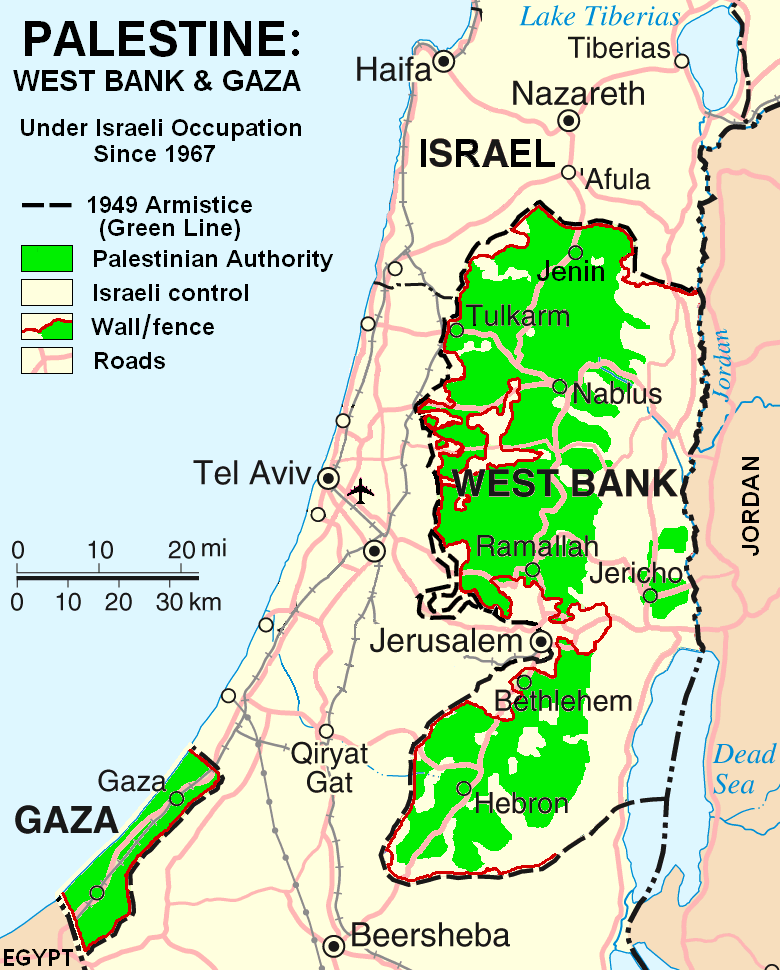
| by Jonathan Kuttab June 5th, 1967, known as the Six Day War, or the Naksa (setback) was a pivotal date in the history of Palestine and its confrontation with Zionism and the State of Israel. For many people, it was an opportunity for a historic compromise between Zionism and Palestinian nationalism, and the Arab world in general, whereby Palestinians would accept the state of Israel in 78% of Palestine, in return for a Palestinian state in 22% (being the West Bank and Gaza, including East Jerusalem). For many Palestinians, this was a painful compromise, reluctantly accepted. For many Israelis, it was only a step along the way to capturing all of Palestine (and beyond) when the opportunity arises. After convincing the world that it started the war in ’67 as a form of “preemptive self defense” fearing the Arab armies were about to attack it, Israel proceeded to gradually annex and absorb the occupied territories through settlement activities. While claiming it had no territorial ambitions there, it steadily acquired more and more land and settled more and more civilian Jews, and set up a dual system of laws, administration and even roads, and showed no genuine willingness to allow Palestinian statehood at all. While different Israeli administrations speeded up or slowed down this process of annexation, all Israeli governments continued along the same path, finding all sorts of excuses to pursue their Zionist goals while pretending to be seeking an accommodation with Palestinians. Throughout the period since 1967, Settlements were not frozen, much less removed, to the point where over 700,000 Jewish settlers have now made the West Bank their home. The guiding principles of all their actions were land and demography. Taking more land, introducing more Jews, and restricting Palestinian growth. The international community bought the deception under the title of “a two-state solution”, and basically asked the Palestinians to forget about 1948 and the Nakba, and to simply concentrate on trying to maintain what they had in the West Bank and Gaza and to work to set up a state in the lands Israel occupied in 1967. When the first Intifada forced some serious negotiations between the PLO and Israel, the two-state solution was the basis of discussion. The Oslo accords were signed as a framework for a peace agreement to be reached within 5 years. The serious issues of the settlements, the final borders, the refugees, and Jerusalem were all left to be discussed later, and a Palestinian Authority (thought to be the nucleus for a Palestinian state) was established on a temporary basis expected to develop into a state eventually. Settlers and the settlements, clearly illegal under international law, become a mere “obstacle to peace”. Settlers were reviled and demonized, but also served as a form of legitimizing Zionism and the state of Israel, forgetting the Nakba, and Palestinian right of return, as well as avoiding any real discussion of the conflict between Zionism and Palestinian nationalism as everyone concentrated on the West Bank and Gaza. “Peace efforts” were aimed at working towards a negotiated solution to come about, while Israel continued inexorably to swallow up more and more of the occupied territories, and deepen the fragmentation of Palestinians as they tightened the noose around Gaza, slowly annexed more and more of the West Bank, and reduced Palestinian leadership (and the Palestinian Authority) to mere municipal functionaries with little or no national authority. Many, myself included, who had enthusiastically worked for the two-state compromise, realized it was no longer possible. Whether Israelis ever seriously contemplated such a compromise or were lying and deceiving the world on this issue all along was irrelevant. Israel’s control over the occupied territories was complete, firm, and apparently irreversible. The “temporary situation” which took shape in 1967 had lasted for decades, and showed no signs of ending. It finally erupted in the disastrous events of October 7, 2023. Immediately after October 7, all talk of two states, or even peace and reconciliation disappeared totally, and the full fury of the Israeli army was launched on Gaza, and to a lesser degree the West Bank. It was not merely a matter of revenge, or restoring deterrence, or defeating Hamas, and eliminating their military power. Instead, it was viewed as an opportunity to continue the original fight against all Palestinians and to advance the original Zionist goals and to end the “Palestine Question” once and for all. The issues now were no longer self determination and coexistence, but the full implementation of the Zionist dreams of creating a Jewish state by replacing Arabs with Jews in all of Palestine. Many in the international community became aware of the struggle for the first time, and for them, the urgent issues were genocide, ethnic cleansing, and an end to the carnage. Ceasefire and negotiations were called for even by those who had accepted the Israeli version of the demonization of Hamas, and the need to eliminate its military power – just as the world had previously sided with Israel and fought the Palestinian people under the guise of fighting the terroristic PLO. For Israelis what counted was how to totally destroy Gaza, and where to send its population. Talk of a Second Nakba surfaced again, and the issues that initially gave rise to the Nakba were again front and center. The nature of Israel as a Jewish state, and the place (if any) for non Jews within that state now rose to the front. Unlike previous bouts of fighting, however, this time, the world could see the true nature of what was happening, and was appalled at the injustice and evil this was wreaking on the Palestinian people, including women and children. The absence—for the time being—of an easy destination to throw out the Palestinians (both Jordan and Egypt have firmly refused to allow this) meant that Israelis had to physically exterminate Palestinians by the hundreds of thousands, and to make life so impossible that the Palestinians would beg to leave and the world would allow their expulsion as a humanitarian measure to end their suffering. It is not clear at all that Israel has abandoned this goal, as it continues to throttle Gaza and also squeeze the Palestinians in the West Bank. It is important to know and remember the history of the conflict: 1948, 1967, and 2023 are important milestones. It is far more important to know the basis and essential elements involved, and to seek to address them. Zionism has always sought to set up a Jewish state in Palestine at the expense of the indigenous population. The essential elements have always been land and demography. To realize that goal it needed to acquire land and bring in Jewish immigrants, while dispossessing and removing non Jewish residents, and denying them their national identity and even physical existence. Those who seek peace, solutions, and justice should not be distracted by bogus solutions, but must deal with this reality and only support solutions and movements that address that fundamental problem, We are often encouraged to be realistic, and not to live in the past. The real and present reality is that two groups of roughly 7 million each live today in the land between the River and the Sea, and neither group is going anywhere soon. Without implying any symmetry between them, historical, ethical or moral, this is the current reality. One group has all the power, and the second group is denied legitimacy and is threatened with genocide and annihilation through sheer power and violence. Until this reality is recognized and remedied, all prospects for peace, stability, resolution, and coexistence are deceptive illusions and pipe dreams. That is the true meaning of June 5, 1967, and all the events before and since that date. |