

By Nourdine Jamal, APAN’s Correspondant in Gaza
anuary 29, 2026
At midnight inside a torn-out and fragile tent, a 40-year-old father named Akram Manasra clutches his two children, 10-year-old Wael and 7-year-old Amal. Violent winds whip the shelter from side to side, threatening at any moment to rip it from the ground.
Desperate to shield them from the biting cold, Akram wraps his children in a thin, worn blanket, barely enough to protect them from Gaza’s freezing winter.
“Winter has become a curse for us, not a mercy as it once was,” Akram says, pulling his children tightly to his chest.
Akram’s family, originally from Gaza City’s Shujaiya neighborhood , have been displaced from one place to another fleeing death. They finally settled in Al-Zahraa displacement camp in downtown Gaza.
“Our children sleep without adequate blankets to protect them from the freezing wind at night,” Akram explained.
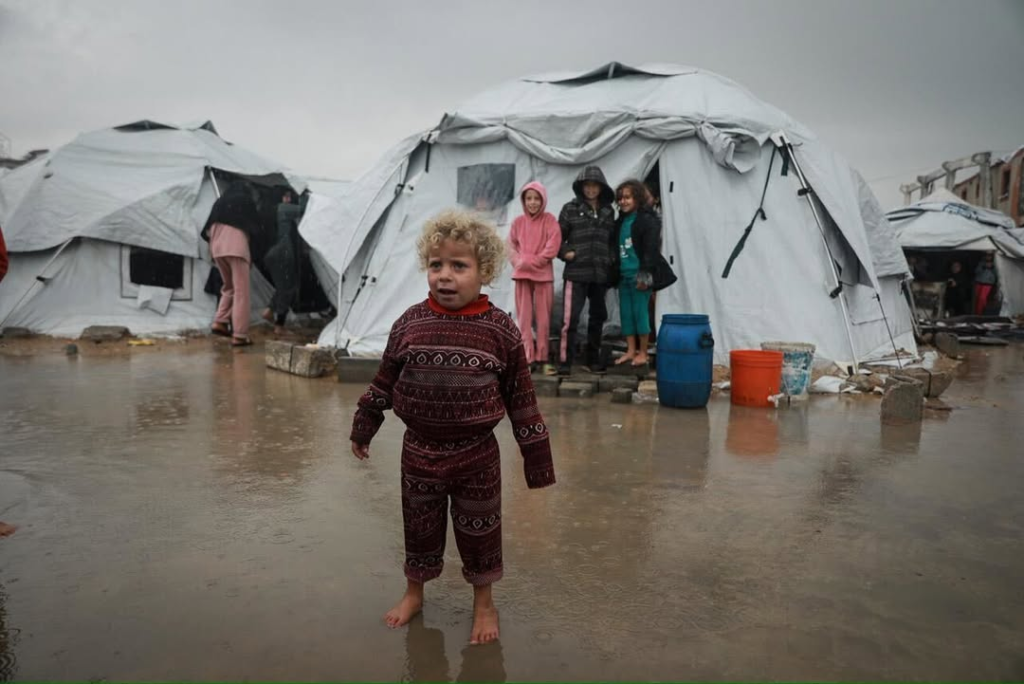
As Gaza sinks into the harshest stretch of winter, children are dying from exposure to the cold, swept away by floodwaters in overcrowded camps, or burned while families attempt to cook inside makeshift tents. After more than two years of war in which nearly nine out of every ten homes have been destroyed by Israel, Palestinians are left sheltering among the rubble, battling fierce winds, battling relentless rain, and enduring freezing temperatures.After a rainy and hard night, Akram wakes to his blankets drenched in water. His tent is too fragile to endure such heavy rain. As I walked into his tent, the floor was full of water that Ahmed, with the help of his family, had been trying to push out.
“We are unable to protect our children from the brutal winter. We feel that we are helpless.” Akram concludes.
During the first months of genocide, Akram lost his two children. What makes his pain even harder is that his third child has been injured, lying inside the frail and flooded tent – Ahmed feels helpless..
In order to escape the rain, Akram recalls sleeping on a school desk, huddled underneath thin blankets alongside his family, barely able to protect them from the rain.
According to news reports, at least eight children in Gaza alone died from hypothermia this winter due to low temperatures, poor shelter, and a shortage of fuel for heating in camp settings, including two week old Mohammed Abu Elkheir this last month.

Image: Nourdine Jamal
Unicef has said that children, whose immune systems are often severely compromised due to malnutrition, are in danger of hypothermia and severe respiratory infections. Children in Gaza are particularly vulnerable when temperatures drop because they are more likely to be uprooted, live in extreme poverty, or not attend school. Even for families who have managed to stay in their houses, months or even years of fighting and unemployment have depleted their finances, making it nearly hard for them to buy heating fuel, warm clothes or home repairs.
While international organisations have supplied shelters and blankets to address the urgent needs of displaced people in Gaza, these humanitarian efforts continue to be obstructed by Israeli authorities, leaving hundreds of thousands exposed to harsh winter conditions.
Akram called his young daughter and asked her to bring the waterlogged mattress from inside their tent. As she did, he looked at it and asked, “Do the people of the world let their children sleep on blankets soaked through with rain? Of course not. They sleep in proper beds.”
Akram paused, his voice heavy with exhaustion and despair.
“All we want,” he said, “is the right to sleep in warmth and under a shelter that can protect us from the harsh weather outside.”
